
Sex Offender Checks in Houston County
The ALEA Community Information Center is Alabama's official public gateway. ALEA CJIS maintains the Alabama Sex Offender Registry, while the Houston County Sheriff's Office and other local law enforcement agencies register people and send current forms, photographs, fingerprints, and reported changes to the state. The state service updates from those local submissions. A county filter is useful for broad community awareness, while a name search is better when the reader already has a specific person in mind.
Start with more than a name when possible. A city, ZIP code, county, or address-based geographic search can narrow common names and reveal nearby results. Then open the full profile and compare aliases, physical details, the registering jurisdiction, and status. A registry match is not the same as a court docket. It reflects a registration duty tied to a qualifying offense, not every filing or allegation connected with a person.
The official ALEA registry gateway shows how Houston County residents enter the state search. The image captures the public starting point without featuring a registrant.
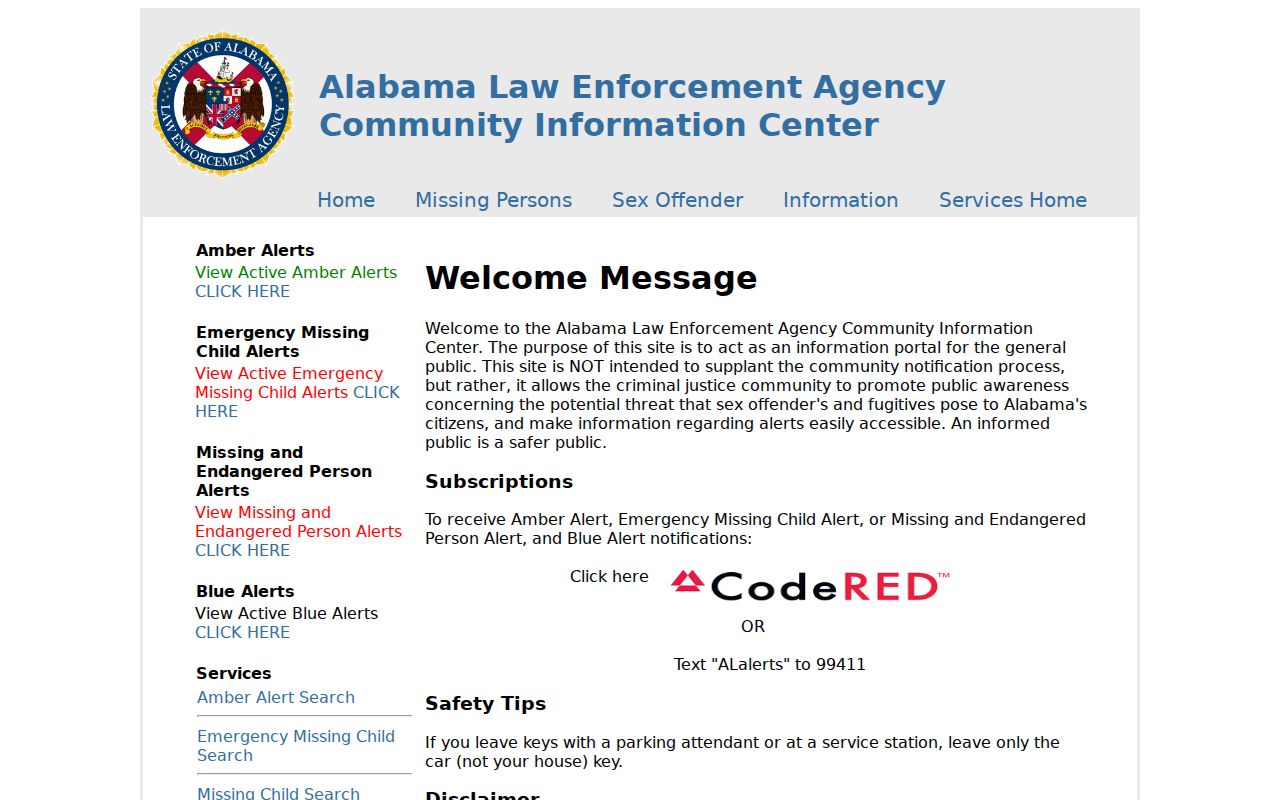
This gateway is the right first stop because it routes readers into the official Alabama registry rather than a commercial people-search service.
Houston County Registry Reporting
The Houston County Sheriff's Office is a local source for registration concerns. An adult registrant reports in the person's birth month and then every three months. Local staff collect the required information, verify compliance, and send the data to ALEA. That split explains why a wrong residence should be reported to local law enforcement, even though the public profile appears on a state website.
The Houston County Sheriff's Office is at 411 North Foster Street in Dothan. Its published contact page lists Criminal Investigations and Records at 334-677-4809 during weekday public hours, 7:30 a.m. to 4:30 p.m. The research did not document a separate public Houston County registry desk or a county-only offender map. Readers should therefore use ALEA for the public search and the sheriff's official contact channel for a local verification concern.
Note: A state profile can only be as current as the registration and change information that reaches ALEA from the responsible local agency.
How to Search the Alabama Sex Offender Registry
The official Alabama registry supports several ways to search. ALEA directs users to its official OffenderWatch-hosted service. The vendor blocked automated inspection during research, so exact button labels, radius choices, sorting, and pagination are not stated. The verified fields below come from Alabama law and ALEA's official materials.
- Open the official Alabama registry from the ALEA Community Information Center and read its conditions of use.
- Choose a name search or enter a place, such as Houston County, a city, a ZIP code, or an address for a geographic search.
- Review the result list and compare names, aliases, photographs, and location details before treating a result as a match.
- Open the full record and read the qualifying offense, conviction jurisdiction, registration status, and reported locality together.
| Search capability | Type | Required | Verified use |
|---|---|---|---|
| Name | Text | No | Search for a known legal name or listed alias. |
| City or town | Text or select | No | Focus results on a named municipality. |
| County | Select | No | Select Houston for county-wide results. |
| ZIP code | Text | No | Limit a place search to a postal area. |
| Geographic radius | Address and radius controls | No | Search around an address; exact radius choices were not verified. |
The official Alabama offender search presents these place and identity routes. Its search view is shown without centering any individual profile.
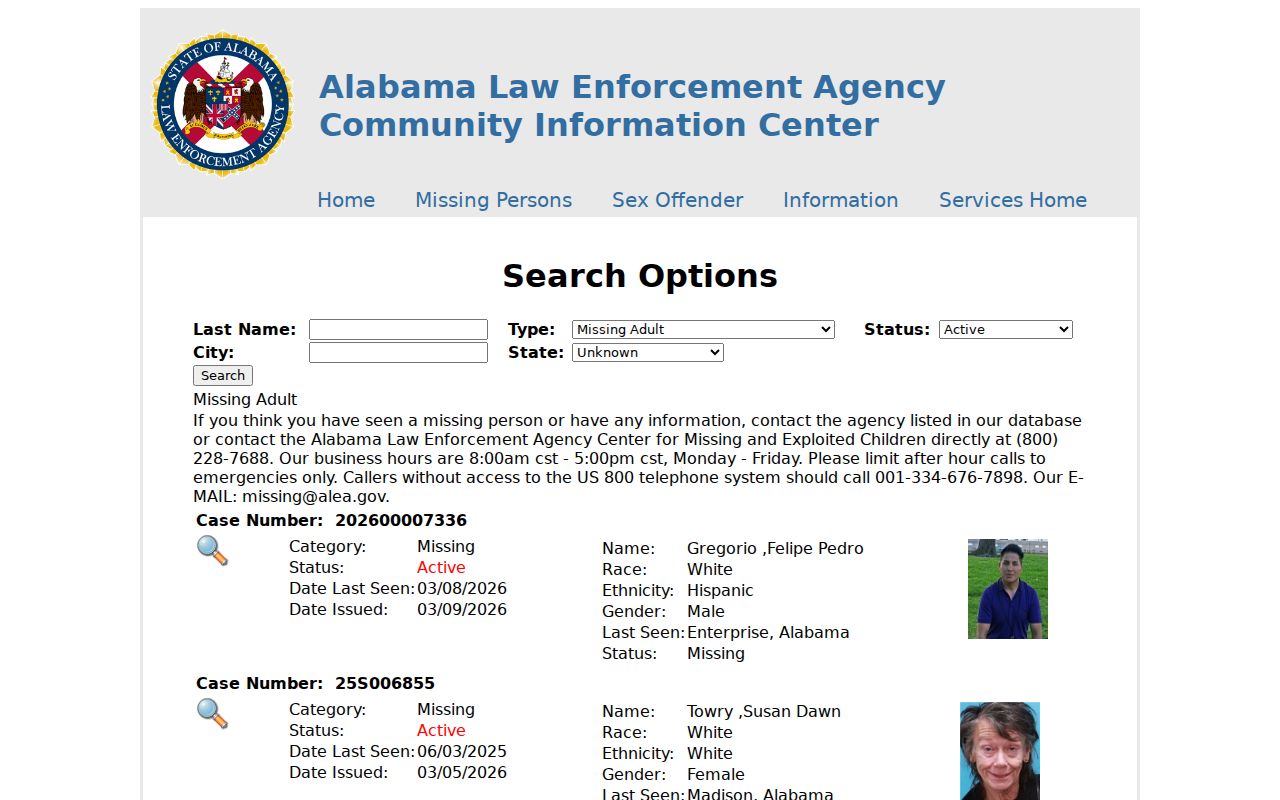
Using a county or address filter first can reduce false matches, but the full profile still needs to be checked before drawing a conclusion.
Houston County Registry Search Layers
ALEA is the best source for an Alabama-focused search because Alabama agencies supply the registration data. The National Sex Offender Public Website, operated by the U.S. Department of Justice, federates searches across participating jurisdictions. It helps when a person may have moved across a state line or when a neighborhood search reaches beyond Alabama.
The two systems serve different scopes. NSOPW does not replace the source jurisdiction's profile, and ALEA does not claim to be a nationwide record. When the national result points back to Alabama, open the Alabama record for the state-specific status and reporting details. When a result belongs to another state, use that state's official registry for the underlying entry.
The DOJ national search offers the cross-state layer for Houston County safety checks. Its official interface is useful when local and state boundaries do not match a person's history.
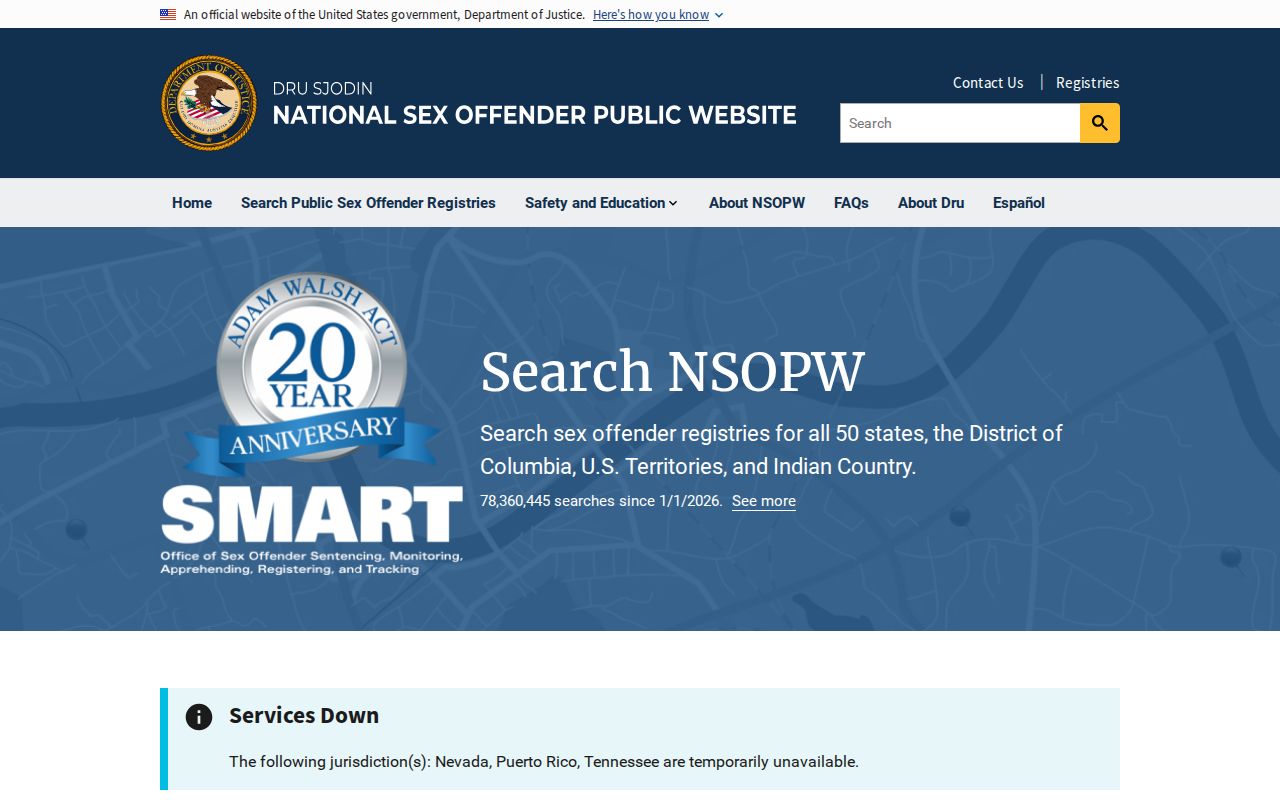
Comparing the national result with the source registry helps keep jurisdiction and current reporting status clear.
Inside a Registry Profile
A public registry profile is a structured safety record. It combines identity details with the reported place, qualifying offense, and registration status. Alabama also collects fingerprints, palmprints, internet identifiers, work or school details, and vehicle information for administration. The research did not verify that every collected field appears publicly, so the inventory distinguishes confirmed public profile content from data used behind the scenes.
| Name and Aliases | Legal name and known aliases used to distinguish similar identities. |
|---|---|
| Photo and Description | A current photograph and physical descriptors supplied through registration. |
| Reported Locality | Residence and other locality information shown by the official profile. |
| Offense Details | The qualifying offense plus conviction jurisdiction and date. |
| Registering Jurisdiction | The local agency responsible for registration and verification. |
| Status | Public compliance or registration information carried by the portal. |
Read the fields as a set. A photograph helps with identity, an alias can explain a name mismatch, and the registering jurisdiction identifies the office that can check a possible error. The qualifying offense is more useful than assuming Alabama assigns the adult a public risk tier, because it does not use the common adult Tier I, II, and III duration scheme.
Note: A profile field should be checked against the complete official record because location, compliance, and registration information can change.
Correcting Houston County Registry Details
If a Houston County address appears wrong, do not confront the person at the listed location. Save the profile link and note the exact field at issue. Report a wrong address, prohibited proximity, or suspected failure to comply to local law enforcement. ALEA states that local agencies verify these facts, which makes the local office the practical first contact.
For a portal or state-record question, the ALEA registry FAQ lists registry help at 334-676-7898 and sexoffenderunit@alea.gov. Give enough detail for staff to identify the record, but do not circulate the profile through neighborhood rumor or use it to threaten anyone. The goal is an accurate official record and a lawful review.
The ALEA FAQ also explains public-inclusion limits and the local verification cycle. The official FAQ screen provides context beyond the short result card.
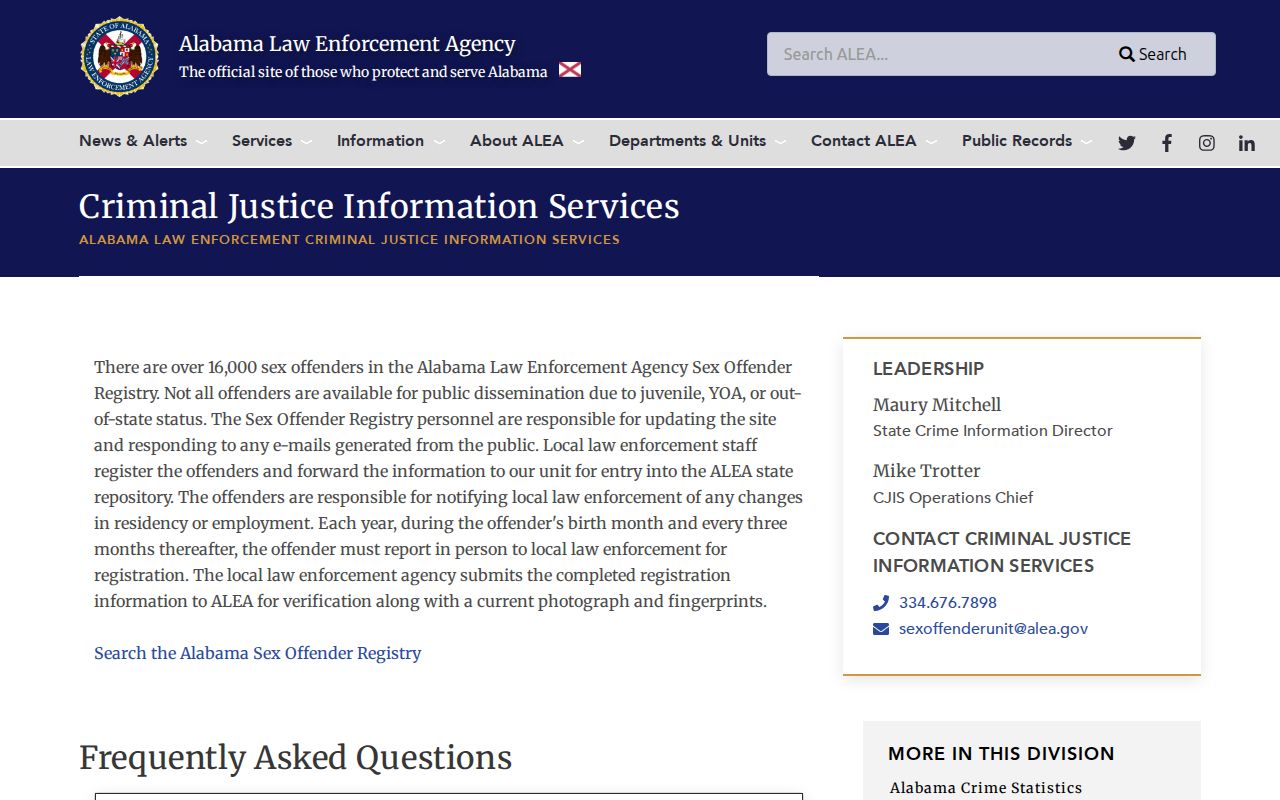
That guidance is especially useful when a court case exists but no public registry profile appears.
Alabama Registration Levels and Requirements
Alabama's adult system is offense-based and generally requires lifetime registration. It is not a public adult tier chart with different Tier I, II, and III terms. Adults register during the birth month and every three months after that. Juvenile rules differ and can use risk findings for notification, but those labels should not be projected onto adult profiles.
| Category | Duration | Verification or public treatment |
|---|---|---|
| Adult sex offender | Life | Birth month and every three months; public after conviction and release, with no adult tier duration. |
| Specified serious juvenile offense at age 14 or older | Life | Relief may be sought after 25 years under the stated statutory conditions. |
| Other juvenile registrant | 10 years from first registration | Juvenile court risk findings affect notification rather than adult duration tiers. |
Publication has limits. ALEA notes juvenile and youthful-offender restrictions, out-of-state due-process limits, certain first convictions, and the statute's list of qualifying offenses. A missing public profile does not prove that no related court record exists. It may mean the case falls outside Alabama's public registry rules.
Houston County Registry Distance Rules
Alabama generally bars an adult sex offender from establishing a residence within 2,000 feet of a school or child-care facility. Community notification under Alabama law also uses a 1,500-foot distance in cities of at least 5,000 people other than the state's four largest cities. That city rule is relevant in Dothan, while other parts of Houston County may follow a different notification setting based on location.
Distance rules do not turn a public search map into a survey. Map pins, street data, and address inputs can be imperfect. If a proximity issue seems possible, send the specific concern to law enforcement for measurement and review. A public user should not declare a violation based only on a rough screen view.
Note: Registry maps support community awareness, but local law enforcement determines compliance after checking the reported address and the applicable rule.
Houston County Registry Search Gaps
Not every sex-related disposition creates a public Alabama registry entry. Alabama publishes people whose offenses and procedural status fall within its registry law. Juvenile and youthful-offender matters have special limits. Certain first convictions for Indecent Exposure or Sexual Misconduct may also be outside public inclusion, and out-of-state cases can require due-process review.
That makes the registry a focused public-safety tool, not a substitute for a Houston County criminal court case file. The Houston County court clerk is the local custodian for filed county cases, while the registry shows the separate duty that follows a qualifying outcome. Readers researching a known case can use the Houston County criminal court case channel for that procedural record.
Community Notification and Lawful Use
Registry access supports personal safety, family planning, and community awareness. Alabama's notification rules work alongside the searchable profile, and ALEA requires a warning against using the information to injure, harass, or commit a crime. Check the source profile before sharing a result because aliases, old screenshots, and unverified social posts can point to the wrong person or an outdated address.
Use official data with care. Keep any report to the sheriff or ALEA factual. Do not visit a listed residence, threaten a registrant, contact a household, or organize retaliation. If an immediate safety issue exists, call law enforcement instead of trying to investigate it personally.
Registry misuse warning: Ala. Code §15-20A-42 requires the public warning that registry information may not be used to injure, harass, or commit a crime. Misuse can lead to criminal consequences.
Note: Report an urgent safety concern to law enforcement and leave compliance investigation to the agency responsible for the official record.