
Houston County Criminal Court Cases
Houston County is part of Alabama's 20th Judicial Circuit. Circuit Court has exclusive original jurisdiction over felony prosecutions. District Court handles most misdemeanor trials and the early stages of felony matters, including preliminary proceedings. The Houston County Circuit Clerk is the official record keeper for both courts. That split matters because a reader who calls the wrong counter may not reach the division that holds the needed Houston County criminal case file.
The clerk divides its work among Circuit Criminal, District Criminal, Traffic, Juvenile, Warrants, and other divisions. A municipal charge may remain with a city court, while a felony proceeds in the county system. Juvenile matters are restricted and do not function like an adult public docket. The filed court case is also distinct from the booking record. For the custody event that comes before filing, the separate Houston County arrest lookup explains the sheriff and jail channels.
Houston County Criminal Court Counters
The criminal counters are in the Houston County Courthouse at 114 North Oates Street in Dothan. Circuit Criminal is in Room 108 and can be reached at 334-677-4858. District Criminal is in Room 109 at 334-677-4869. The clerk publishes public hours of 8:00 a.m. to 4:30 p.m. on weekdays, with the courthouse closed from noon to 1:00 p.m. The official room directory is the best check before a visit.
Use Circuit Criminal for a felony prosecution and District Criminal for a misdemeanor or a felony matter still at the district stage. Traffic has a separate line at 334-677-4870. The Houston County clerk office directory separates those divisions, and the official Circuit Clerk profile explains the office’s record duties and electronic imaging. Staff can explain record access and certification. They cannot give legal advice or interpret what a ruling means for a party.
Houston County Circuit Clerk
Houston County Courthouse
114 N. Oates St.
Dothan, AL 36303
Circuit Criminal: 334-677-4858
District Criminal: 334-677-4869
Searching Houston County Case Records
Just One Look is the Alabama Unified Judicial System's official case-by-case remote channel. An account and payment are required. It allows a name search or case-number search, then provides a case detail report when a match is opened. AlaFile is mainly the court's e-filing and service system, so it should not be confused with the public search. Follow the court level and record type rather than treating every state court product as the same database.
- Decide whether Circuit Criminal, District Criminal, or Traffic is the likely Houston County division.
- Create or sign in to a Just One Look account, then choose a name or case-number search.
- Enter only the fields the portal requests. Do not assume it offers a date-of-birth or county filter behind the login.
- Open the matching Houston County case detail and read the case-action summary, status, settings, and available images.
- Ask the proper clerk division for a certified copy, an older file, or help with a record that is not remotely available.
| Field or control | Type | Required | What is verified |
|---|---|---|---|
| Search method | Navigation | Yes | Name Search or Case Number Search after login |
| Account email and password | Text and password | Yes | Remote search is login gated |
| Name | Search | Method dependent | Name search is offered; detailed fields are not public |
| Case number | Search | Method dependent | Case-number search is offered |
A search cost displayed in July 2026 was $9.99 for a name or case-number search, including one case detail. A no-match name result still counted as a search. Extra case details were $9.99 each. Available document images were $5 for the first 20 pages, then $0.50 per page. Confirm the live price before paying.
Just One Look Case Detail
The official Just One Look source shows the statewide court-record channel that Houston County readers use for remote case access.
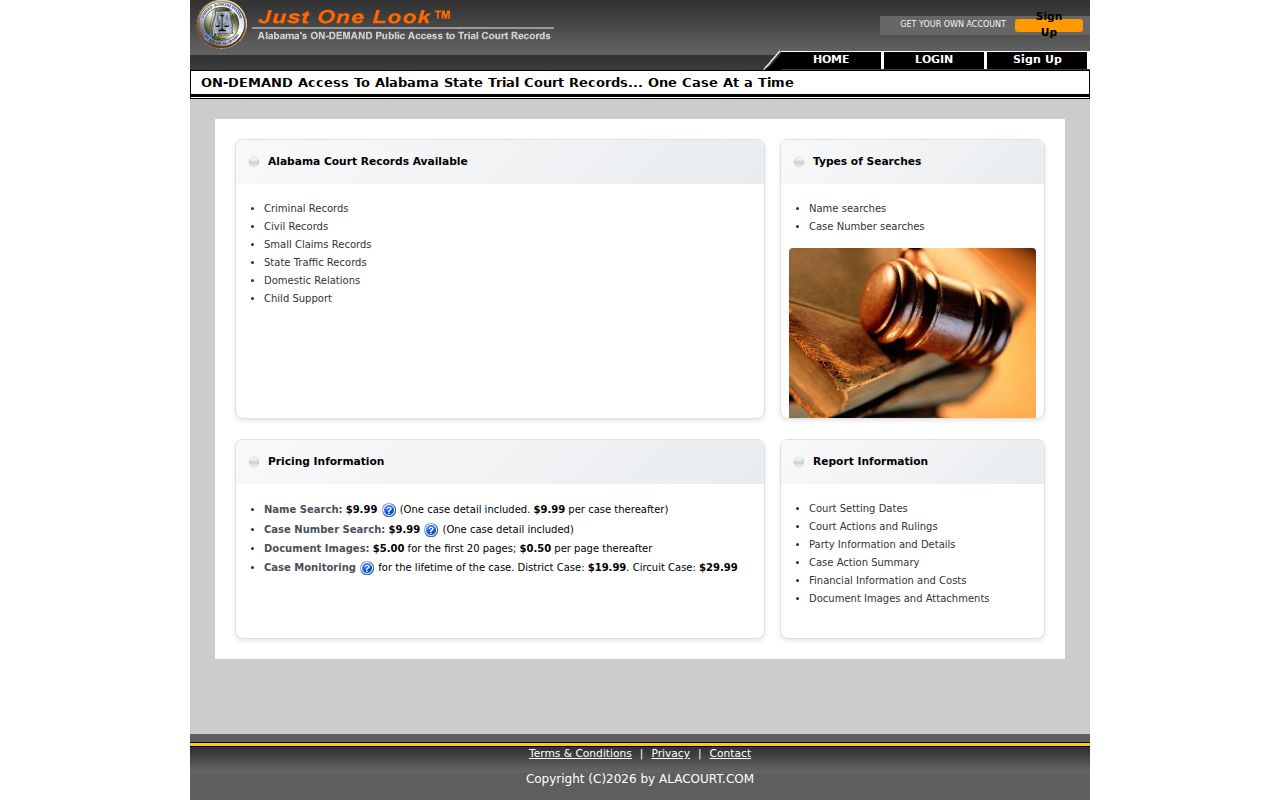
The image identifies the correct court product, while the clerk remains the source for certified Houston County criminal case records and material not available online.
Remote case detail can include the case number, court, type, current status, court action, hearing or setting dates, party details, financial history and costs, docket events, and purchasable images or attachments. The public product page does not promise that every file shows a birth date, victim name, bond type, prosecutor, restitution, sentence conditions, or linked cases. Those unverified fields should not be assumed. A direct clerk request is the sound fallback when one of them matters.
Inside a Houston County Case File
A Houston County criminal case file records what happened after a charge was filed. It is not a statewide fingerprint-based rap sheet, and it is not merely the jail's intake entry. Read the docket as a chronology. A charge shown at booking may be revised, replaced, or never filed after prosecutorial review. The filed charging paper and the disposition are therefore more useful for understanding the court outcome.
| Case number and court | Identifies the Houston County division and the specific court action. |
|---|---|
| Filed charge | Shows the charge placed before the court, which may differ from the booking label. |
| Case status | Indicates whether the matter is pending, closed, or otherwise classified by the court. |
| Case-action summary | Lists docket events, filed papers, hearings, orders, and other activity in date order. |
| Disposition and judgment | Records how each filed charge ended and whether guilt was established. |
| Financial information | May show court costs and other financial entries available in the case detail. |
Note: A portal result is useful for review, but a certified Houston County court record must come from the clerk.
Houston County Charges Can Change
An arresting officer records the suspected offense. The jail records the booking charge. Prosecutors then decide what charge, if any, should be filed in Houston County criminal court. That sequence explains why an arrest entry and a court docket may not use the same wording. It also explains why release from jail does not prove that the court matter ended.
Compare the arrest date and arresting agency with the Houston County case number and filed charge. Then read through the last disposition entry. If no court case appears, the matter may not yet have been filed, the name may be entered differently, access may be restricted, or the arrest may not have matured into prosecution. The absence of a remote hit is not enough to choose among those possibilities. Contact the clerk and the agency that created the arrest report.
How a Criminal Case Moves
A felony matter may begin with a complaint and district-level proceedings before moving to Circuit Court. A misdemeanor usually remains within District Court unless a municipal court has jurisdiction. At each stage, the clerk adds filings, settings, pleas, orders, and the outcome to the Houston County criminal case record. Timing varies by case, so the research does not support a fixed county schedule for these steps.
Case flow: Charges Filed › Arraignment › Pretrial › Plea or Trial › Disposition › Sentencing
The flow helps a reader locate the most useful document. The charging instrument identifies the filed accusation. Arraignment records the plea. Pretrial entries can show motions and settings. The disposition says how a charge ended. A sentence follows a conviction, while an acquittal, dismissal, or nolle prosequi has a different meaning.
Houston County Disposition Terms
Short docket terms can hide a major difference in outcome. Read each term beside the related charge because a Houston County case can resolve different counts in different ways. These plain meanings help with a first review, though the clerk cannot give legal advice and the signed order controls.
- Disposition
- The recorded way a charge ended.
- Nolle prosequi
- A prosecutor's formal decision not to proceed with the charge.
- Dismissal
- The charge ended without a conviction.
- Acquittal
- A not-guilty determination after the matter was decided.
- Conviction
- Guilt established by a plea or verdict.
- Case-action summary
- The clerk's date-ordered record of events in the case.
Older Houston County Criminal Case Files
A missing online image does not mean the Houston County criminal case never existed. The clerk states that most trial information is electronically imaged, which leaves room for older, restricted, or otherwise non-remote material. Call the correct criminal division with the case number when possible. If only a name and rough time period are known, explain that clearly and ask what index or counter method is available.
The courthouse is also the route for free in-person inspection of accessible court records under Alabama's court-record rules. Copy and certification prices for Houston County criminal files were not published in the official sources reviewed. Ask for the current charge before ordering. Do not substitute a civil fee schedule. For a file that appears incomplete, identify the exact docket entry or document needed rather than requesting every record tied to a broad name.
Case Record Access & Restrictions
Alabama's public-record starting point is Ala. Code §36-12-40, but court access has limits. Juvenile and youthful-offender matters, expunged records, victim and minor identifiers, sealed investigative facts, and sensitive personal data may be withheld or redacted. Alabama's Rules of Court-Record Privacy and Confidentiality took effect in 2025 and govern the public court file separately from ALEA's restricted criminal-history repository.
The ALEA expungement gateway illustrates the official route for Alabama forms and record-removal guidance.
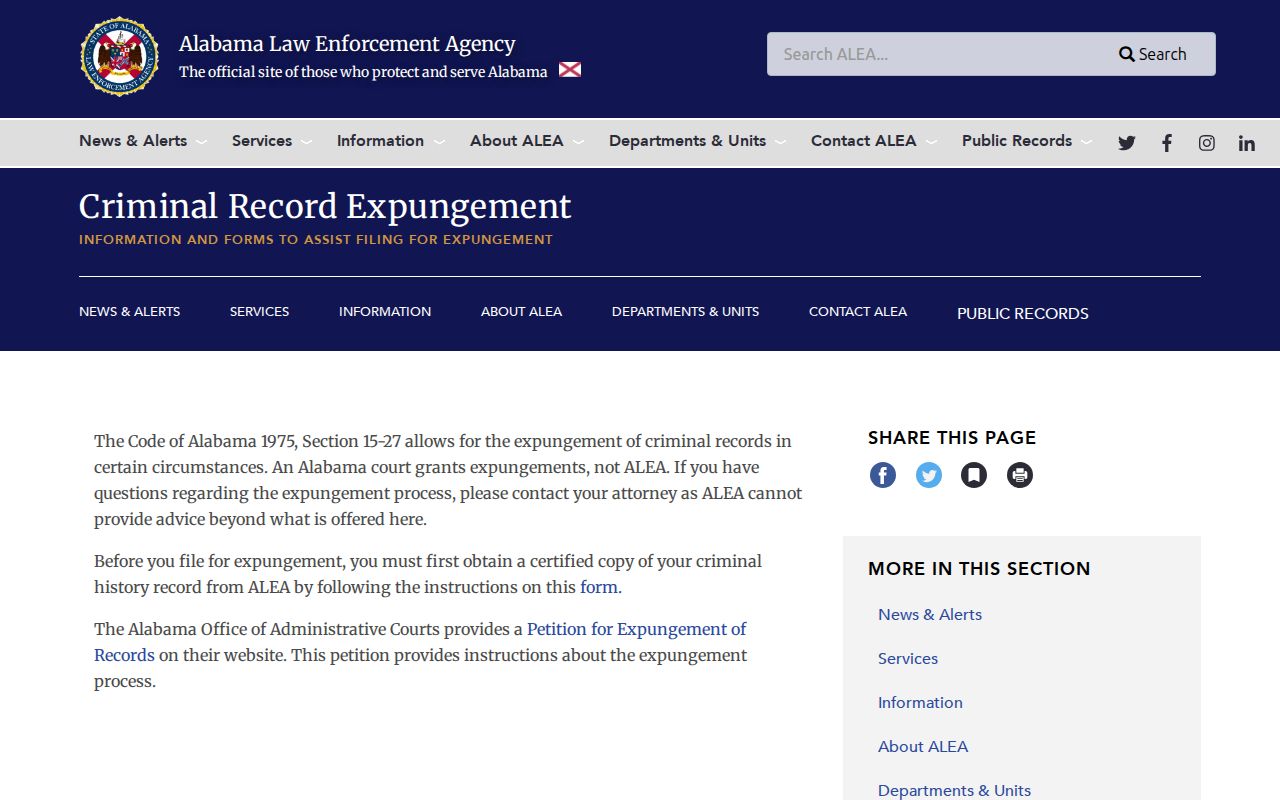
The image points to state guidance, but an eligible Houston County petition is filed through Circuit Court and relief is granted by a court, not by ALEA alone.
An expunged record does not stay in the ordinary public index. If a Houston County case cannot be found, ask the clerk about availability without assuming why it is absent. A redacted view may confirm that a case exists while protecting data the public may not inspect. ALEA's fingerprint-linked criminal history is another product with tighter dissemination rules. Open courthouse access does not convert that state repository into a general public name search.